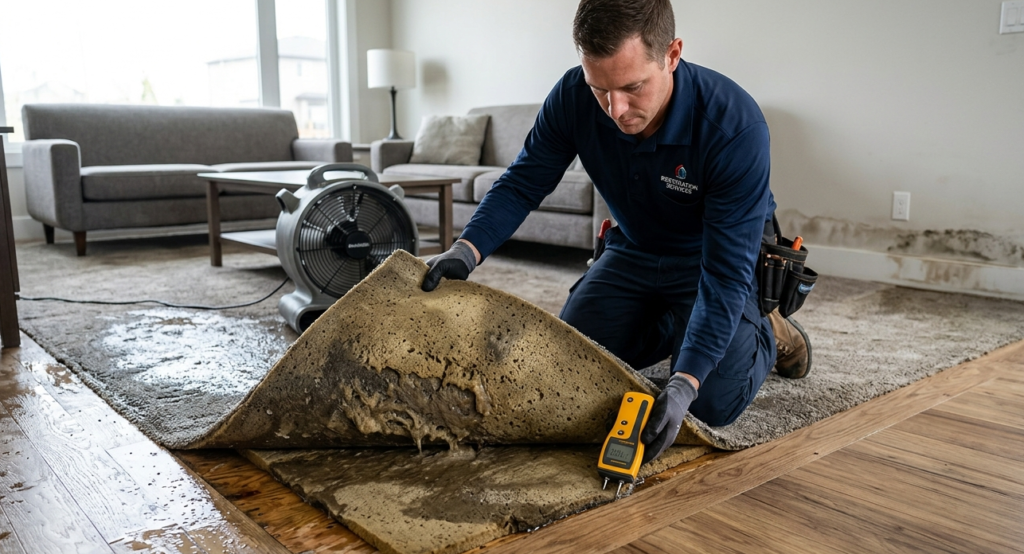
It’s one of the most common questions we get after a water damage event: can my carpet be saved, or does it all have to go?
The honest answer is – it depends. And what it depends on matters more than most homeowners realize. Make the wrong call and you either spend money replacing carpet that could have been dried and kept, or you spend far more money later dealing with mold that grew in carpet that should have been removed immediately.
This guide breaks down exactly how restoration professionals make that decision, what the science behind it looks like, and what you can do in the first few hours to protect your options. Whether you’re dealing with a burst pipe in Riverside or a washing machine overflow in your laundry room, the framework is the same.
The Two Factors That Determine Everything
Restoration professionals assess water-damaged carpet against two variables, in this order:
1. What category of water caused the damage.
2. How much time has passed since the damage occurred.
Neither factor alone gives you the full picture. A carpet soaked in clean water for six hours is a completely different situation from a carpet soaked in clean water for four days – even though the water source is identical. And a carpet soaked in sewage-contaminated water for ten minutes is a different situation from one soaked in clean water for ten minutes, even though the time is the same.
Understanding how these two factors interact is how restoration professionals determine whether your carpet gets dried or gets removed.
The Water Category System: What Got Into Your Carpet
The professional standard for classifying water damage comes from the IICRC S500 – the technical document published by the Institute of Inspection, Cleaning and Restoration Certification that governs how certified restoration companies approach water damage. The IICRC S500 defines three categories of water, and each one carries different implications for your carpet.
Category 1: Clean Water
Category 1 water originates from a sanitary source and does not pose a substantial health risk from exposure. Common sources include:
- A broken water supply line inside a wall
- An overflowing bathtub or sink with clean water
- A malfunctioning water heater
- A refrigerator ice maker line failure
This is the best-case scenario for carpet salvage. According to IICRC guidelines, carpet exposed to Category 1 water can typically be saved if professional extraction and drying begin within 24 to 48 hours of the event. The carpet face fiber itself can often be cleaned, treated with antimicrobial agents, and dried in place.
There is an important exception even with clean water: the carpet pad almost always needs to be replaced. Carpet pad is designed to be dense and absorbent – which is exactly what makes it a terrible candidate for drying after water damage. It holds moisture deep inside its structure long after the surface feels dry, creating ideal conditions for bacterial growth even when the water source was clean. Most restoration professionals remove and replace the pad as a standard part of Category 1 carpet restoration, even when the carpet itself is being kept.
Category 2: Gray Water
Category 2 water contains some level of contamination that could cause illness or discomfort if ingested or contacted. Common sources include:
- Washing machine discharge
- Dishwasher overflow
- Toilet overflow containing only urine (no solid waste)
- Water that has been sitting stagnant long enough for bacterial growth to begin
Gray water carpet situations are more complicated. The carpet itself may be salvageable with professional extraction and antimicrobial treatment, but the decision depends heavily on how long the water has been present and how saturated the materials are. The carpet pad almost always must be replaced in Category 2 situations because it cannot be adequately disinfected.
One critical detail about Category 2: it degrades over time. Category 2 water that has been sitting in carpet for more than 48 hours transitions to Category 3 due to bacterial proliferation and the potential onset of mold. A washing machine overflow that was addressed quickly is a very different problem from a dishwasher leak discovered three days later even though the water source was identical.
Category 3: Black Water
Category 3 is the most serious classification. Black water is grossly contaminated and carries pathogens, toxins, or other agents that present significant health risks. Sources include:
- Sewage backups
- Toilet overflows containing solid waste
- Flooding from rivers, storm drains, or external surface water
- Any standing water that has become heavily contaminated over time
There is no gray area with Category 3 water and carpet. According to IICRC S500 standards, all porous materials exposed to Category 3 water – including carpet, carpet pad, and in many cases porous subfloor materials – must be removed and discarded. No amount of cleaning, extraction, or antimicrobial treatment makes Category 3-exposed carpet safe for continued use.
This is not a conservative professional opinion. The EPA is equally clear: absorbent or porous materials such as carpet may have to be thrown away if they cannot be adequately cleaned and dried. When contamination is at Category 3 levels, carpet cannot be adequately cleaned – full stop.
If you’ve experienced a sewage backup or external flooding, do not attempt to clean the carpet yourself. This is a biohazard situation that requires protective equipment, proper containment, and disposal protocols that consumer cleaning products cannot replicate.
The Time Factor: Why Hours Matter More Than You Think
Even in the best-case Category 1 scenario, time is working against you from the moment water contacts your carpet.
The EPA recommends beginning drying within 24 to 48 hours of water damage – and that window is not conservative buffer room. It is the outer edge of the period before mold colonization becomes likely under normal indoor conditions. Mold spores are already present in virtually every indoor environment. When they land on wet, warm carpet, they don’t need an invitation – they need only moisture and time.
Here is what the timeline looks like in practical terms:
0–2 hours: Carpet and pad are saturated but water hasn’t migrated significantly into subfloor or wall base. Full carpet restoration is achievable with professional extraction and drying if water is Category 1.
2–24 hours: Water has migrated more deeply. The pad is thoroughly saturated. Subfloor materials may be absorbing moisture. Professional drying is still likely to save the carpet face fiber if water is Category 1, but the scope of work increases.
24–48 hours: This is the outer limit for Category 1 salvage. The EPA notes that water-damaged areas dried within this window can usually be saved without mold growth. Beyond this point, Category 1 water has likely degraded toward Category 2 conditions due to bacterial growth in the standing water.
48+ hours: At this point, any water – regardless of original category – has had enough time to create conditions where mold growth is either underway or imminent. The EPA specifically notes that mold may be hidden in places such as the underside of carpets and pads, which is exactly why professional moisture assessment matters even when the surface feels dry.
72+ hours: Structural materials beyond the carpet itself are at serious risk. Category 1 water has now degraded. Subfloor damage is increasingly likely. The scope of work has expanded significantly.
This is why restoration professionals always ask two questions when they arrive: “What was the source of the water?” and “When did you discover it?” Both answers together determine what can be saved.
What Happens During Professional Carpet Restoration
If the damage category and time window support salvage, here is what a proper professional carpet restoration process looks like – so you know whether the company you’ve called is doing the job correctly.
Moisture assessment first. Before any equipment is placed, a technician should use moisture meters to map the extent of saturation in the carpet, pad, subfloor, and surrounding wall bases. This step tells the crew the true scope of the problem – not just what’s visible. Thermal imaging cameras can identify hidden moisture pockets beneath the surface that meters alone might miss.
Extraction. Truck-mounted or portable extraction units remove the bulk of standing water from the carpet far more effectively than any consumer wet-dry vacuum. Thorough extraction is the single most important step in carpet restoration – the more water removed mechanically, the less work the drying equipment has to do and the faster drying proceeds.
Pad removal. In the vast majority of cases, the carpet pad is pulled and removed at this stage. The carpet face fiber is then folded back to allow airflow to both sides and to the subfloor beneath.
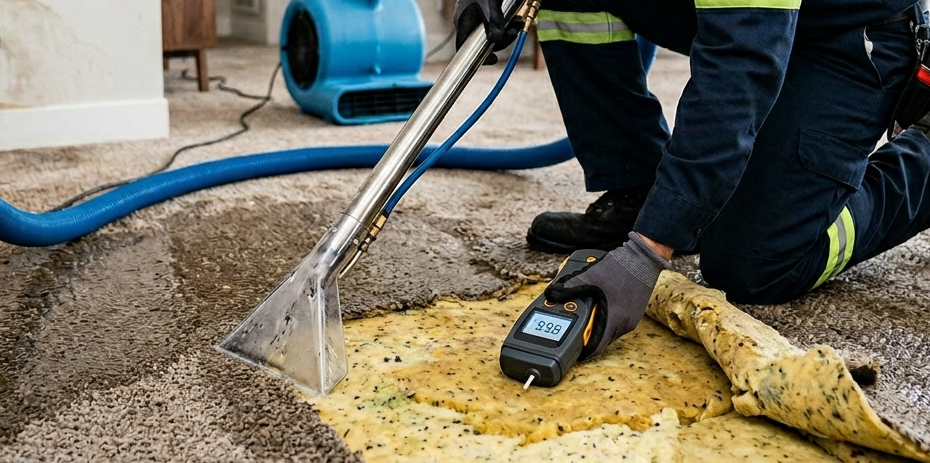
Subfloor assessment. The exposed subfloor is checked for saturation and structural integrity. Depending on the material – plywood, OSB, or concrete – and the degree of saturation, additional drying steps may be needed before the new pad and carpet are relaid.
Drying equipment placement. Industrial air movers and commercial dehumidifiers are positioned throughout the affected area following drying protocols that account for room size, ambient conditions, and the specific materials involved. This equipment runs continuously – typically for three to five days – to bring all materials to safe moisture levels.
Antimicrobial treatment. EPA-registered antimicrobial agents are applied to the carpet fiber, the subfloor, and all affected wall bases to prevent mold growth during and after the drying process.
Daily moisture monitoring. A technician should return each day to take moisture readings and document the progression. Equipment is adjusted based on actual readings – not estimated timelines. The job is not complete until moisture meters confirm that all materials have reached dry standard.
Carpet cleaning and reinstallation. Once structural drying is confirmed, the carpet is professionally cleaned, treated, and relaid over new pad.
For a detailed look at how water extraction and drying work as part of a complete restoration, Plus 1 Restoration & Carpet Care’s water extraction service page walks through what to expect from the equipment and process in a Riverside-area water damage event.
Why Consumer Equipment Usually Isn’t Enough
The most common mistake homeowners make after water damage is reaching for a shop vacuum and some box fans, assuming the carpet will dry out on its own. Here is why that approach almost always falls short.
Consumer-grade dehumidifiers typically remove 30 to 50 pints of water per day. Industrial commercial dehumidifiers used by restoration professionals remove 70 to 150 pints per day per unit — and a professional crew places multiple units in affected spaces. The difference in drying speed is not marginal; it can mean the difference between carpet drying safely in three days and carpet still harboring hidden moisture after a week.
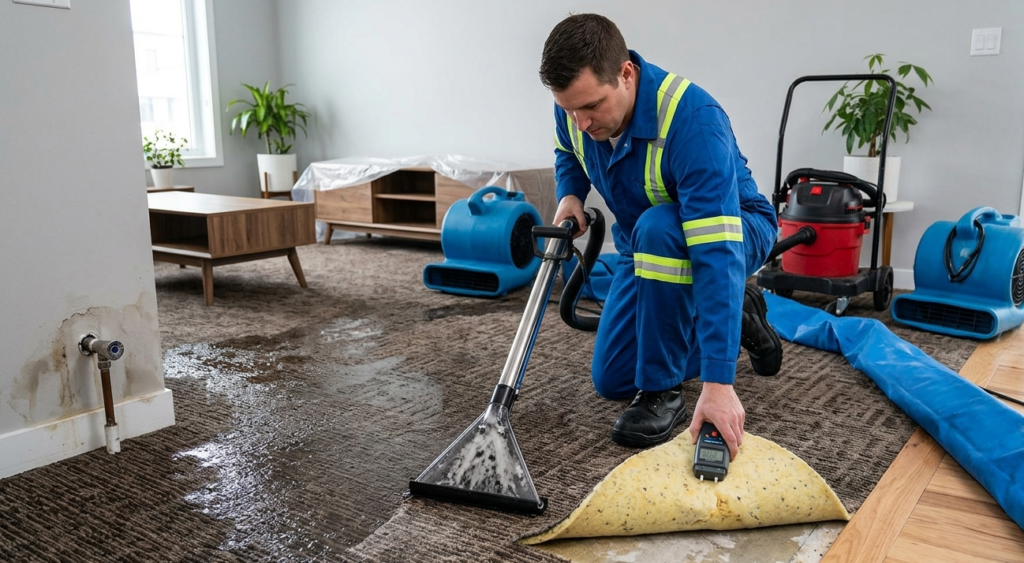
Box fans move air horizontally at low velocity. Industrial air movers are designed to create high-velocity airflow across surfaces, dramatically accelerating the rate of evaporation from carpet fiber and structural materials. Consumer fans simply cannot replicate this.
The deeper problem with insufficient drying is that it produces carpet that feels dry at the surface but remains wet inside the fiber and pad beneath. That hidden moisture is exactly where mold establishes itself first. By the time you smell it or see discoloration, a colony is already present.
Professional drying equipment and moisture monitoring are critical to preventing secondary damage. Learn more about our complete water damage restoration process in Little Rock.
When Carpet Cannot Be Saved: What Comes Next
If your carpet falls into the replacement category – whether due to Category 3 water, extended time, or the discovery of active mold the restoration process shifts from drying to controlled removal.
Contaminated carpet and pad are removed carefully to avoid spreading contaminants or disturbing mold colonies. In Category 3 situations, this work requires personal protective equipment and proper disposal procedures. Materials are bagged and disposed of according to applicable regulations – they cannot simply go in the regular trash.
The subfloor beneath is thoroughly dried, treated with antimicrobial agents, and assessed for structural integrity. Depending on the subfloor material and degree of saturation, some subfloor sections may need to be replaced before new flooring can be installed.
If active mold is discovered beyond the carpet and pad – in the subfloor, wall base, or lower sections of drywall – the scope of work expands into mold remediation, which follows its own containment and remediation protocols separate from the carpet removal work.
Once all affected materials are removed, dried, and treated, the space is ready for reconstruction – new pad, new carpet or alternative flooring, and any drywall or wall base repairs needed to return the space to pre-loss condition.
The Mold Risk Nobody Talks About
Here is the part of the carpet water damage conversation that often gets skipped: the risk doesn’t end when the carpet is dry.
Mold spores are present on virtually every surface in a normal indoor environment at concentrations that are harmless. The problem begins when moisture creates a growth environment – and once a colony establishes itself inside carpet fiber or underneath pad, it doesn’t stop at the carpet. It spreads to subfloor materials, works into wall bases, and given enough time, establishes itself inside wall cavities where it becomes extremely difficult and expensive to address.
The EPA is direct about this: failure to remove contaminated materials and reduce moisture and humidity can present serious long-term health risks. Standing water and wet materials are a breeding ground for microorganisms, including mold, that can cause disease and trigger allergic reactions.
This is not a theoretical future problem – it is a predictable consequence of inadequate or delayed drying. Restoration professionals who understand this treat carpet water damage as a time-sensitive structural and health issue, not just a cleaning job.
For context on how this plays out in real situations: water damage restoration teams across different markets – whether serving Riverside County homeowners dealing with pipe failures or teams in other parts of the country handling storm-related flooding – all face the same fundamental challenge. The mold clock starts at the moment of water contact, regardless of geography. A certified restoration company in the mid-South dealing with storm flooding faces the same 24-to-48-hour drying window as one handling an appliance failure in Southern California.
What You Should Do Right Now
If you are reading this because you have wet carpet in your home right now, here is the priority sequence:
Stop the water source if it is still active. Shut off the main water supply if the source is a pipe or appliance failure.
Get people and pets out of heavily saturated areas, particularly if there is any possibility of sewage contamination or if water is near electrical outlets or panels.
Document everything before cleanup begins. Take photos and video of the affected rooms, the water source, and any visible damage. This documentation supports your insurance claim and should be done before anything is moved or removed.
Call a certified restoration company immediately. Do not wait until morning. Do not assume the carpet will dry on its own. The 24-to-48-hour window that determines whether your carpet can be saved starts now, not when it’s convenient.
Call your insurance company within 24 hours to notify them of the damage. Most homeowners policies cover sudden and accidental water damage from internal sources. Document the source of water precisely when you report – this distinction shapes how your claim is processed.
In Riverside and throughout the Inland Empire, Plus 1 Restoration & Carpet Care provides 24/7 emergency water damage response with IICRC-certified technicians who can assess your carpet situation, determine what can be saved, and begin extraction immediately. Same-day response – call (951) 433-4147.
Can water-damaged carpet be saved? Often yes – if the water source was clean, if you act within 24 to 48 hours, and if you use professional extraction and drying equipment that can do the job at the speed the mold prevention window requires.
Sometimes no – if the water was contaminated, if too much time has passed, or if mold is already present. In those cases, trying to save the carpet costs more in the long run than removing it immediately.
The most reliable way to know which situation you are in is to have a certified restoration technician assess the damage as quickly as possible. The assessment itself is fast. What the assessment tells you – and what you do with that information in the next few hours – is what determines whether your carpet makes it through.
For 24/7 emergency water damage response in Riverside, CA and surrounding Riverside County communities including Moreno Valley, Corona, and the Inland Empire, call Plus 1 Restoration & Carpet Care at (951) 433-4147. IICRC-certified technicians, free estimates, direct insurance coordination.
Leave a Reply